
News
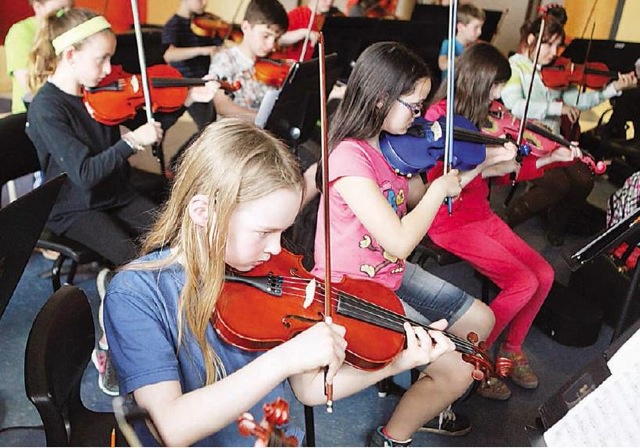
It’s four o’clock on a warm afternoon and the sun is shining in the basement windows of the Queen Elizabeth School cafeteria.
The tables are pushed up against the back wall and the rest of the space is crammed with 40 little kids sitting at 40 plastic little-kid chairs facing 40 music stands.
The sun and the fresh air and the playground are all outside. Inside, the air is warm and close and smelling of the lunch leftovers in the garbage cans the custodians haven’t yet been able to empty because they don’t want to interrupt the serious work that goes on for three hours every day after school, Monday to Friday, September to June.
In a little while the kids will indeed take a break and dash outside to hit the playground equipment, but right now not a single one of the children ages 9-12 is showing any signs of interest in starting the weekend.
Each is too busy pursuing excellence.
These kids are the strings section and they’re rehearsing their part in an upcoming concert June 10 and they are, without any exaggeration, absolutely owning this music.
Close your eyes and you see men in tuxedos and women in gowns playing in some great symphony hall, following the intense and almost angry-looking direction of some great and towering maestro, the whole lot of them performing with the practised precision of decades of passionate toil.
Open your eyes and you’re back in a 60-year-old brick box of a school, and the classical musicians before you are wearing Cows T-shirts and camo pants with mud-stained knees and runners with Velcro for shoelaces. In some cases, the musicians’ instruments are as big as they are.
The conductor they’re following is obviously the real deal even if he is wearing jeans too, and there’s no question he’s passionate, but watch Antonio Delgado and you know the passion is as much about teaching kids as it is about the music.
Watch the kids and it’s harder to figure out. They look like ordinary North American kids, a generation better known for excelling at Xbox and listening to hip-hop than mastering Handel.
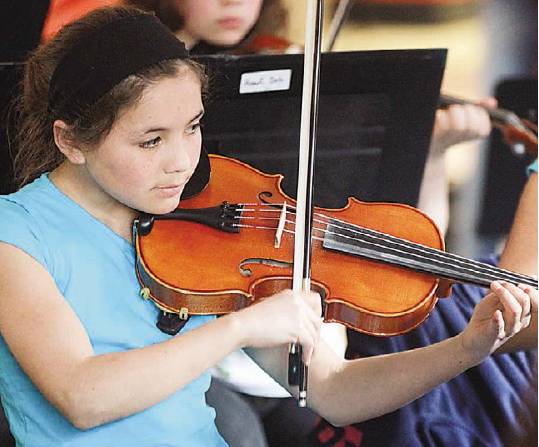
Claudia Mallet rehearses with Sistema at Queen Elizabeth School. PHOTO: VIKTOR PIVOVAROV/TIMES & TRANSCRIPT
They don’t look like the button-down children of society parents, bored and suffering through a weekly violin lesson. In fact, many – though not all – kids involved in this marvellous thing tend to come from financially disadvantaged families that wouldn’t be able to fund their children’s musical educations and instruments if they had to pay.
At the moment they’re in the midst of the Hallelujah Chorus, but every piece they play is an ode to joy.
Tony Delgado points out afterward that this is not some kid-friendly, watered- down musical arrangement. This is the same one the adults in the world’s symphonies play. It is Handel and it is hard.
And that is why the kids are so happy. They know they can do something normally only adults, and few adults at that, can do.
And why can’t they excel?
“Kids without resources have every bit as much capacity for genius as kids with resources,”says Ken MacLeod, the president and CEO of the New Brunswick Youth Orchestra, which took this outreach on after seeing its extraordinary success changing lives in Venezuela.
Three of the kids this day, Malcom Mealey, Chloe Brubacher and Claudia Mallet, take time after rehearsal to talk about how much they enjoy playing their violin, viola and bass, respectively.
All said they like being with the friends they’ve made and are proud of what they can do.
“It’s fun,” Chloe said, to nods of agreement from her bandmates.
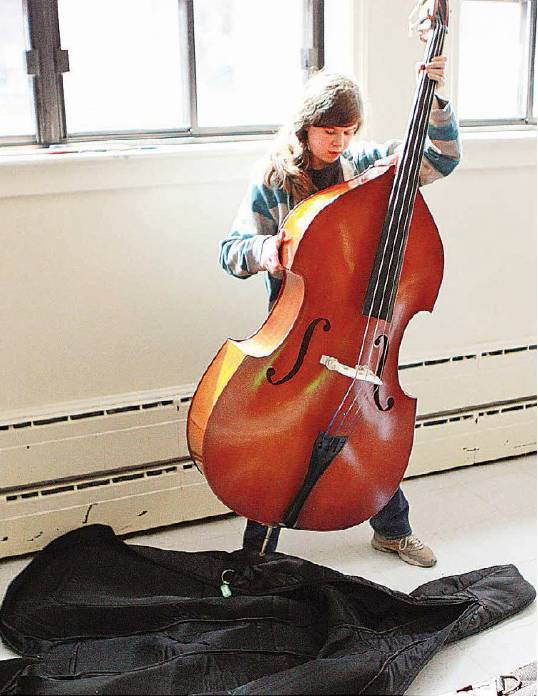
Chloe Brubacher gets her double bass ready to play at Queen Elizabeth School. PHOTO: VIKTOR PIVOVAROV/TIMES & TRANSCRIPT
“It” is la Sistema, which translates literally to “the system” but in New Brunswick at least, has really translated into excellence.
What was initially a one-year pilot project few thought would work is now five years old. What was initially one teacher and 50 kids in Moncton is now 520 children and 37 teaching professionals, working in Moncton, Saint John, Richibucto and Tobique First Nation.
Through a free daily after-school program, Sistema NB uses music and the orchestra as a tool to inspire children to reach their full potential. Children learn music skills but much more including focus, discipline, respect and co-operation. They develop confidence and self-esteem and they build a solid foundation in their lives for the future.
“It’s paying off. It’s not just the way they play. It’s the discipline,” Delgado says. “Music is an absolute. It’s either in tune or it’s out of tune.”
Says the conductor, “to have fun, it has to be good. Kids are emotional beings and they get that.”
Catherine Gagné came to Moncton from Quebec with her fellow Sistema NB teacher husband and their children. They bought a house and are putting down roots here because of Sistema.
“Before coming here I was at the Conservatoire in Gatineau and it was the traditional style,” she says. There is nothing wrong with that, but meet Catherine and it’s obvious she is one of those people who is as passionate about teaching and working with children as she is about music. She also likes the camaraderie and sense of mission she has found with Sistema NB.
“It’s a really big family, a big team. It’s fantastic. I found finally the way I want to teach.”
She also loves the way she and her colleagues are seeing the changes in the kids they teach, the discipline of making music and the confidence from doing it well translating into all the other aspects of the children’s lives. Today, Sistema NB is the largest of its kind in Canada and a respected leader at home, in Canada and internationally.
The Fifth Anniversary Concert of Sistema NB will be held Tuesday, June 10, at 7 p.m. at Moncton Wesleyan Celebration Centre.
Roughly 250 young musicians, four orchestras and three special guest choirs – Le Choeur Neil Michaud, Riversong, and Anglophone East District Choir – will take part.
The finale performance will be the Hallelujah Chorus, performed by the 100-member Sistema NB Moncton Children’s Orchestra and mass choir, with more than 200 artists on stage.
Admission is free and everyone is welcome, but organizers expect a full house.
